
How AI Sentiment Analysis Transforms Employee Survey Results
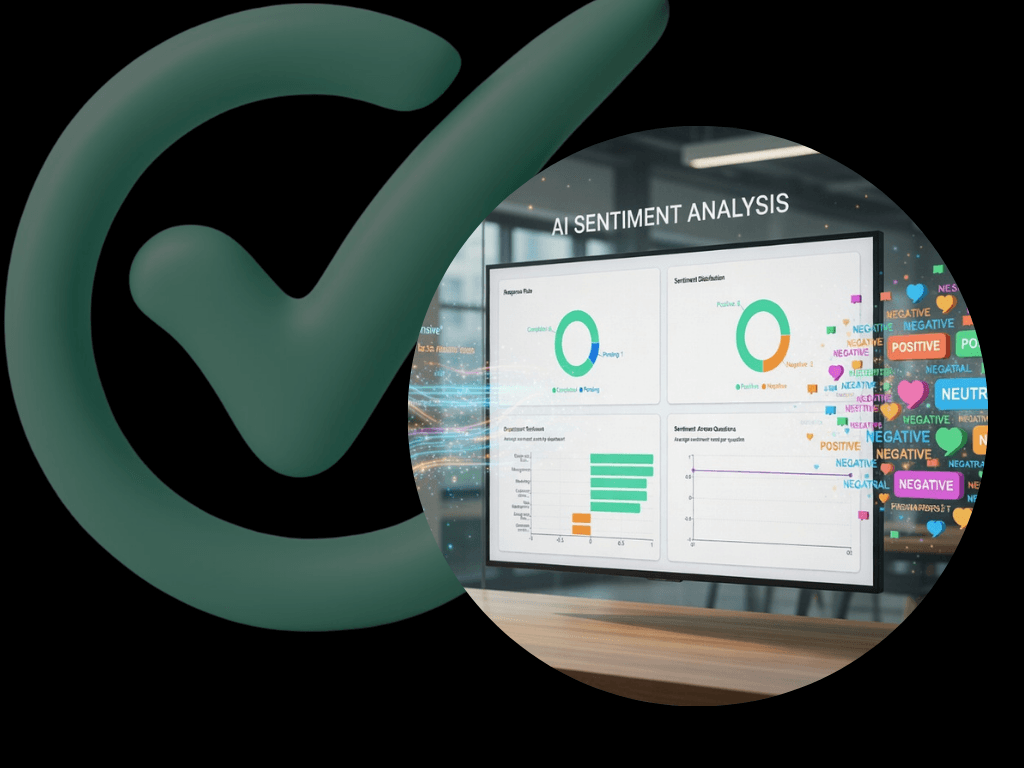
You sent the survey. Responses are in. Now what?
For most HR teams, the answer is: open a spreadsheet, read hundreds of open-ended responses one by one, try to spot patterns, and produce a summary that's inevitably shaped by whichever responses happened to stand out. The process takes days, the conclusions are subjective, and by the time the report reaches leadership, the data is already stale.
AI sentiment analysis changes the equation entirely. Instead of reading every response manually, AI processes all of them simultaneously — classifying sentiment, extracting themes, and generating actionable insights in minutes rather than weeks.
This guide explains exactly how it works and why it matters for your team.
The Problem with Manual Survey Analysis
Before diving into AI capabilities, it's worth understanding why manual analysis falls short:
Volume: A 50-person company running a 15-question survey generates 750 individual responses. A 500-person company generates 7,500. No one reads 7,500 responses carefully.
Subjectivity: Two analysts reading the same set of responses will often reach different conclusions. The responses they read last tend to disproportionately influence their summary.
Speed: Manual analysis of a mid-sized company survey takes 5-15 business days. By the time leadership sees results, the sentiment landscape may have already shifted.
Nuance blindness: Humans are good at detecting obvious complaints. We're much worse at detecting faint praise — responses that sound acceptable on the surface but carry subtle signals of disengagement or dissatisfaction.
How AI Sentiment Analysis Works
AI sentiment analysis uses natural language processing (NLP) to evaluate the emotional tone, content, and patterns in text responses. Here's what happens under the hood:
Step 1: Response-Level Classification
Every open-ended response is scored on a spectrum from -1 (strongly negative) to +1 (strongly positive), then classified as positive, neutral, or negative.
Consider these two responses to "How would you describe team collaboration here?":
Response A: "Our team works really well together. People are genuinely helpful and we have great communication across projects."
Response B: "People generally do their own thing. There's not much conflict but also not much collaboration. It's fine."
A human reader might classify both as acceptable. AI correctly identifies Response A as strongly positive and Response B as neutral-to-negative — the phrase "it's fine" and the pattern of minimizing language ("not much," "generally") are reliable indicators of disengagement.
Step 2: Per-Question Aggregation
After scoring individual responses, the AI aggregates sentiment by question. This reveals which topics generate the most polarized reactions:
- "How do you feel about your workload?" → 65% negative (a problem)
- "Do you feel respected by your colleagues?" → 85% positive (a strength)
- "How well does leadership communicate company direction?" → 50% neutral (ambiguity worth exploring)
This per-question view is far more actionable than an overall engagement score because it tells you exactly where to focus.
Step 3: Theme Extraction
Beyond sentiment scoring, AI identifies recurring themes across responses. When 30% of employees independently mention "meetings" in negative contexts, that's a signal. When "career growth" appears frequently alongside neutral-to-negative sentiment, that's another.
Theme extraction turns qualitative data into quantifiable patterns that would take a human analyst days to identify manually.
Step 4: Actionable Suggestions
The most advanced AI analysis doesn't just describe what it found — it suggests what to do about it. Based on the patterns detected, the system generates specific recommendations:
- "Multiple responses indicate uncertainty about career progression. Consider implementing transparent promotion criteria or scheduling career development conversations."
- "Workload concerns are concentrated in the Engineering department. The sentiment gap between Engineering and other departments suggests a resource allocation issue."
Real-World Impact: Manual vs. AI Analysis
| Metric | Manual Analysis | AI Analysis |
|---|---|---|
| Time to insights | 5-15 business days | Minutes |
| Responses processed | Limited by analyst capacity | All responses, simultaneously |
| Consistency | Varies by analyst | Identical methodology every time |
| Nuance detection | Good for obvious sentiment | Detects faint praise, hedging, disengagement signals |
| Scalability | Breaks down at 100+ responses | Scales to any volume |
| Cost | Analyst hours ($2,000-$10,000 per cycle) | Included in survey cost |
The difference isn't marginal — it's transformational. Organizations using AI analysis report receiving actionable insights 8x faster and identifying 3x more themes compared to manual review.
Detecting Disengagement Before It's Too Late
One of AI's most valuable capabilities is identifying early disengagement signals that humans consistently miss.
The Language of Disengagement
Disengaged employees rarely write "I hate working here." Instead, they use patterns like:
- Minimizing language: "It's okay," "not bad," "fine I suppose"
- Vague praise: "Things are generally good" without any specifics
- Passive voice: "Feedback is sometimes given" instead of "My manager gives me feedback"
- Short responses: One-word or one-sentence answers to open-ended questions
- Deflection: Answering about the team or company instead of their personal experience
AI models are trained to recognize these patterns. A response that reads as "neutral" to a human reader might score as early-stage disengagement when the AI detects three or four of these signals simultaneously.
Department-Level Patterns
When AI analysis is combined with department-level filtering, you can spot systemic issues that individual conversations would never surface:
- Is one team significantly more negative than others on the same questions?
- Are new hires (< 6 months) reporting different experiences than tenured employees?
- Did sentiment shift after a management change, reorganization, or policy update?
These cross-cutting insights require analyzing hundreds of data points in context — exactly what AI excels at.
What Makes Good AI Survey Analysis
Not all AI analysis is equal. Here's what to look for:
Transparency
The system should show you why it classified a response as positive, neutral, or negative. Black-box scores without explanation aren't trustworthy for HR decisions.
Per-Question Breakdowns
Overall sentiment scores are a starting point, but the real value is in per-question analysis. A survey can have 80% positive overall while hiding a critical problem in one specific area.
Written Analysis
Raw numbers need interpretation. The best AI analysis generates written summaries that explain the patterns, highlight outliers, and connect findings to potential actions. This is what you share with leadership — not a spreadsheet of sentiment scores.
Consistency
The same response should always get the same score. AI provides this by default, but it's worth verifying that the system doesn't produce erratic results across similar inputs.
How VerifyRef Handles AI Survey Analysis
VerifyRef's employee survey feature includes AI sentiment analysis with every survey at no additional cost:
- Response-level scoring: Every open-ended answer is classified as positive, neutral, or negative with a sentiment score from -1 to +1
- Overall survey analysis: Aggregated sentiment across all responses with a written summary of key findings
- Per-question breakdowns: See which questions generated the strongest reactions
- Actionable suggestions: AI-generated recommendations based on detected patterns
- Anonymous mode compatible: AI analysis works identically whether the survey is anonymous or named
The analysis runs automatically once responses come in — no additional configuration needed. Results appear in your dashboard alongside response data and can be exported as professional PDF reports.
Since VerifyRef uses the same platform for reference checks and employee surveys, you get a unified view of both candidate evaluation and team feedback in one tool.
Getting Started with AI-Powered Surveys
If you're currently analyzing survey results manually — or worse, not surveying at all because the analysis burden is too high — AI sentiment analysis removes the biggest barrier.
Here's a practical starting point:
- Run a short pulse survey (5-8 questions, mix of rating scales and open-ended)
- Enable anonymous mode to maximize honest responses
- Review the AI analysis within hours of responses coming in
- Share findings with your team within a week
- Compare results quarter-over-quarter to track trends
The credit-based pricing makes this accessible: 1 credit per 2 survey recipients, with 3 free credits when you sign up. No subscriptions, no monthly fees.
Start your first AI-analyzed survey →
Learn more about employee survey best practices or how exit surveys reduce turnover. Explore the full feature list or read about AI in reference checking.