
Top 10 Reference Check Questions for Employers (2026)

A vague reference check question gets you a polite "they were great" and little else. The right questions—asked the same way for every candidate—surface performance patterns, collaboration gaps, and rehire signals before you extend an offer.
Below are the 10 reference check questions HR teams and recruiters rely on most in 2026, with notes on what to listen for. Run them through automated reference checking software for consistent delivery and AI analysis, or use them in your own process. Comparing tools? See our reference checking software comparison.
Why Structured Questions Matter More Than Ever
Before diving into the questions, it's critical to understand why a structured approach outperforms ad-hoc conversations:
Consistency Across Candidates
When every referee answers the same core questions, you can compare candidates on a level playing field. This eliminates the randomness of unstructured phone calls where each conversation takes a different direction. Learn more about why automated reference checking solves this problem at scale.
Legal Compliance and EEOC Protection
The EEOC requires that background checks and reference inquiries are applied equally to all applicants regardless of race, sex, age, religion, or national origin. Standardized questionnaires ensure you never inadvertently ask questions that violate federal, state, or local anti-discrimination laws.
Deeper, More Honest Feedback
Written questionnaires give referees time to reflect and provide thoughtful, detailed answers. See how the process works in practice. Research shows that referees are more candid in written responses than in live phone conversations, where social pressure can lead to surface-level praise.
The 10 Essential Reference Check Questions
These questions are organized into four key assessment areas: performance verification, interpersonal skills, growth potential, and cultural fit. Together, they give you a 360-degree view of any candidate.
Performance Verification
1. "Can you describe the candidate's primary responsibilities in their role, and how effectively did they fulfill them?"
Why it works: This open-ended question verifies the candidate's account of their role while revealing how the referee perceives their competence. Listen for specifics, vague or generic answers can be a red flag.
What to look for:
- Concrete examples of responsibilities
- Alignment with what the candidate described
- Enthusiasm or hesitation in the response
2. "How would you rate the quality and consistency of the candidate's work on a scale of 1-10, and can you give an example?"
Why it works: Combining a quantitative scale with a qualitative example prevents referees from giving a non-committal answer. The number forces a position; the example provides evidence.
What to look for:
- Scores below 7 warrant deeper exploration
- Whether the example matches the score
- Patterns across multiple referees
3. "Can you describe a significant challenge or project the candidate faced and how they handled it?"
Why it works: Past behavior is the strongest predictor of future performance. This question reveals problem-solving ability, resilience, and how the candidate operates under pressure.
What to look for:
- Specificity of the example
- Whether the candidate took initiative or waited for direction
- The outcome and what the candidate learned
Interpersonal and Communication Skills
4. "How did the candidate communicate and collaborate with team members, managers, and other departments?"
Why it works: In 2026's hybrid and remote work environments — especially for recruitment agencies managing distributed talent — communication skills are non-negotiable. This question assesses whether the candidate can work effectively across different levels and channels.
What to look for:
- References to specific communication styles (written, verbal, cross-functional)
- Ability to adapt communication to different audiences
- Any friction or conflict mentioned
5. "How did the candidate handle feedback or constructive criticism?"
Why it works: Coachability is one of the strongest predictors of long-term success. A candidate who resists feedback will plateau quickly, regardless of their technical skills.
What to look for:
- Openness to receiving feedback
- Evidence of behavioral change after feedback
- Emotional maturity in difficult conversations
Growth Potential and Reliability
6. "What are the candidate's greatest strengths, and what areas would benefit from further development?"
Why it works: This balanced question avoids the trap of only hearing positives. Phrasing development areas as "areas that would benefit from further development" rather than "weaknesses" encourages honest, constructive responses.
What to look for:
- Strengths that align with the role requirements
- Development areas that are manageable or already improving
- Whether multiple referees identify the same patterns
7. "Was the candidate reliable and consistent in meeting deadlines and commitments?"
Why it works: Reliability is fundamental but often overlooked in reference checks. This question directly addresses dependability, punctuality, and follow-through, traits that can make or break a hire.
What to look for:
- Specific examples of reliability (or lack thereof)
- Patterns of missed deadlines or excuses
- How the candidate handled situations when they couldn't meet a commitment
8. "How quickly did the candidate learn new skills, tools, or processes?"
Why it works: In a rapidly evolving workplace, learning agility matters more than static knowledge. This question reveals whether the candidate can adapt to your organization's unique systems and evolving demands.
What to look for:
- Speed of onboarding in their previous role
- Willingness to learn outside their comfort zone
- Self-directed vs. requiring hand-holding
Cultural Fit and Values Alignment
9. "How would you describe the candidate's work ethic and attitude in the workplace?"
Why it works: Skills can be taught, but attitude is deeply ingrained. This question surfaces the candidate's energy, motivation, and overall approach to their work, helping you assess cultural fit.
What to look for:
- Positive descriptors (proactive, enthusiastic, committed)
- Any mention of negativity, entitlement, or disengagement
- Alignment with your company's values
10. "Would you rehire this candidate? Why or why not?"
Why it works: This is often considered the single most revealing reference check question. It forces the referee to make a definitive judgment. Hesitation, qualifications, or a flat "no" are immediate signals worth exploring.
What to look for:
- An enthusiastic, unqualified "yes" is the gold standard
- Conditional answers ("yes, but in a different role") reveal fit issues
- Silence or hedging is itself a powerful data point
Customizable Templates for Different Roles
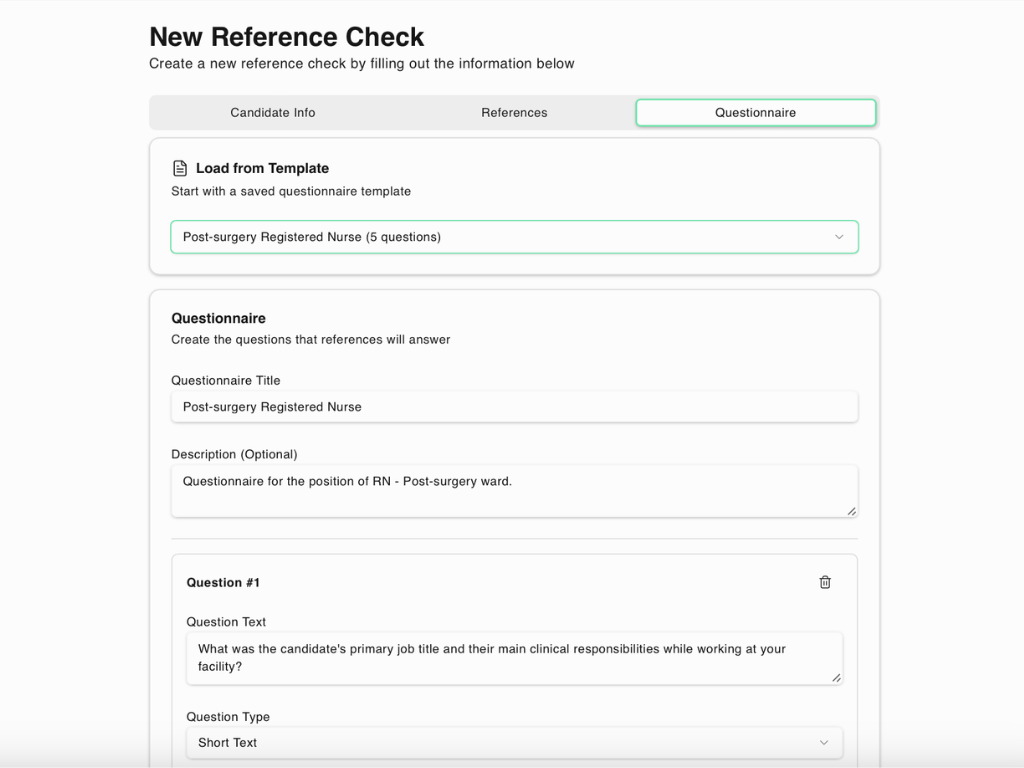
Not every position requires the same reference check approach. VerifyRef's customizable template builder makes it easy to adapt. Here are template variations for your hiring needs:
Template A: Senior Leadership Roles — Talent Acquisition Teams
Add these questions to the core 10:
- "How did the candidate drive strategic initiatives and manage organizational change?"
- "Can you describe their approach to developing and mentoring team members?"
- "How did they handle high-stakes decisions with incomplete information?"
Template B: Technical and Engineering Roles
Add these questions to the core 10:
- "How would you rate their technical problem-solving skills and code quality?"
- "Did they contribute to knowledge sharing, documentation, or team upskilling?"
- "How did they balance speed of delivery with technical quality?"
Template C: Customer-Facing Roles — Small Business & Retail
Add these questions to the core 10:
- "How did the candidate handle difficult customer interactions or complaints?"
- "Can you describe their approach to building and maintaining client relationships?"
- "How did they perform under high-pressure, fast-paced conditions?"
Legal Compliance: What You Cannot Ask
Protecting your organization is just as important as gathering insights. In 2026, reference check compliance must account for federal, state, and local regulations:
Never ask about:
- Medical conditions, disabilities, or mental health history
- Pregnancy, family planning, or parental status
- Religious beliefs or practices
- Age, race, ethnicity, or national origin
- Genetic information or family medical history
- Sexual orientation or gender identity
- Workers' compensation claims
Always ensure:
- Written candidate consent is obtained before contacting referees
- The same questions are asked for every candidate applying for the same role
- All responses are documented and stored securely
- Questions are directly related to job performance and requirements
Pro tip: Using a platform like VerifyRef with standardized, structured questionnaires ensures consistency across every candidate, reducing the risk of inadvertently verbally asking prohibited questions. See our full feature list for details.
How to Maximize Response Quality
Even the best questions are useless if referees don't engage meaningfully. Here are proven strategies:
1. Explain the Purpose
Let referees know their feedback directly impacts the candidate's opportunity. Most people take the responsibility seriously when they understand the stakes.
2. Make It Convenient
Mobile-responsive, asynchronous questionnaires dramatically outperform phone calls. Referees can respond on their own schedule, from any device. Platforms like VerifyRef achieve 95%+ response rates by prioritizing convenience. Learn how it works.
3. Mix Question Types
Combine open-ended questions with scale ratings and yes/no questions. This variety keeps referees engaged while giving you both qualitative depth and quantitative data for easy comparison.
4. Follow Up on Red Flags
If a written response raises concerns, don't hesitate to schedule a brief follow-up call. The questionnaire gives you a structured foundation; targeted follow-ups help you dig deeper where it matters.
Automate Your Reference Check Questionnaires
Manually sending, tracking, and analyzing reference questionnaires is time-consuming and error-prone. Automated reference checking with platforms like VerifyRef transforms the process—or compare reference checking software if you are evaluating vendors:
- Automated distribution — questionnaires are sent instantly when a candidate submits referee details
- Smart follow-ups — the system automatically nudges unresponsive referees
- AI sentiment analysis — responses are analyzed for positive, neutral, and negative patterns
- Fraud detection — IP tracking, email verification, and response pattern analysis flag suspicious activity
- Centralized reporting — all feedback is compiled into a single, easy-to-read report with AI-generated insights
This means you spend less time chasing referees and more time making confident hiring decisions.
The Bottom Line
The quality of your reference checks directly impacts the quality of your hires. By using these 10 structured questions as your foundation, customizing templates for specific roles, and leveraging automation to ensure consistency and compliance, you'll uncover the insights that actually predict on-the-job success.
In 2026, there's no excuse for guesswork. Equip your team with the right questions, the right process, and the right technology.
Ready to Build Better Reference Check Questionnaires?
VerifyRef gives you expert-designed questionnaire templates, AI-powered analysis, and automated delivery—see how reference checking works or compare reference checking software. Start with 3 free reference checks.
Need help customizing your questionnaire templates? Contact our team or explore our complete feature list.